
November 11, 2026
A penalty for acquiring Bitcoin and other digital assets? The banking fees Panama needs to explain
Panamanian banks charge fees of up to 15% on certain cryptocurrency transactions, while a payment infrastructure concentrated in traditional institutions dominates interbank transfers and digital payments. Are we looking at legitimate risk management or economic barriers that limit monetary freedom, innovation, and competition?

Panama, November 11, 2026
Money is much more than a medium of exchange. It is a form of expression.
When someone decides to save in dollars, hold gold, invest in stocks, or acquire Bitcoin, they are expressing an economic preference. They are expressing which instruments they trust, how they wish to protect their wealth, and which system they consider appropriate for sending, receiving, or storing value.
For some, Bitcoin represents an investment opportunity. For others, it is a savings tool, a global payment system, or an alternative to dependence on traditional financial intermediaries.
In any of these cases, the choice of money is part of an individual's economic autonomy.
What happens, then, when a banking institution imposes an extraordinary fee for using its services to acquire a form of money or an asset that the consumer considers appropriate for their needs?
Are we looking at a legitimate charge for a financial service or an economic penalty that discourages certain decisions?
These questions take on particular relevance in Panama, where numerous banks apply surcharges known as Quasi-Cash, or cash equivalents, that can reach 15% of the amount of certain transactions, including the acquisition of Bitcoin and other cryptocurrencies.
But the problem could be much broader than a bank fee.
In Panama, the main interbank payment infrastructures and some of the most widely used digital platforms are closely linked to traditional financial institutions.
This structure raises a necessary discussion about market concentration, economic interests, transparency, and the conditions under which new payment methods can compete with existing ones.
Because if the same rules must apply to all participants in the financial system, the commercial interests of those who administer traditional infrastructures must also be examined.
What Is Quasi-Cash, and Why Do Banks Charge for Acquiring Bitcoin?
Quasi-Cash is a category used by international card networks and financial institutions to classify certain transactions that allow people to acquire money or instruments readily convertible into cash.
It can include purchases of foreign currency, money orders, traveler's checks, account funding, casino chips, certain financial instruments, and the acquisition of digital assets.
The Visa and Mastercard networks use merchant category codes, known as MCCs, to identify these transactions.
When a purchase is classified as quasi-cash, the issuing bank may apply a special fee under the card's contractual terms.
It is important to emphasize that this surcharge is not a tax established by the Government of Panama.
It is a fee charged by the bank.
Nor should it be confused with the fee an exchange charges for facilitating the purchase and sale of Bitcoin.
A consumer may therefore end up simultaneously paying the exchange platform's fee, their bank's Quasi-Cash surcharge, and the applicable taxes on services.
Certain credit cards may also accrue additional financing interest.
What is particularly questionable is that an electronic transaction can become extraordinarily more expensive simply because of the nature of the asset the consumer decided to acquire.
Which Banks Charge Quasi-Cash Fees in Panama?
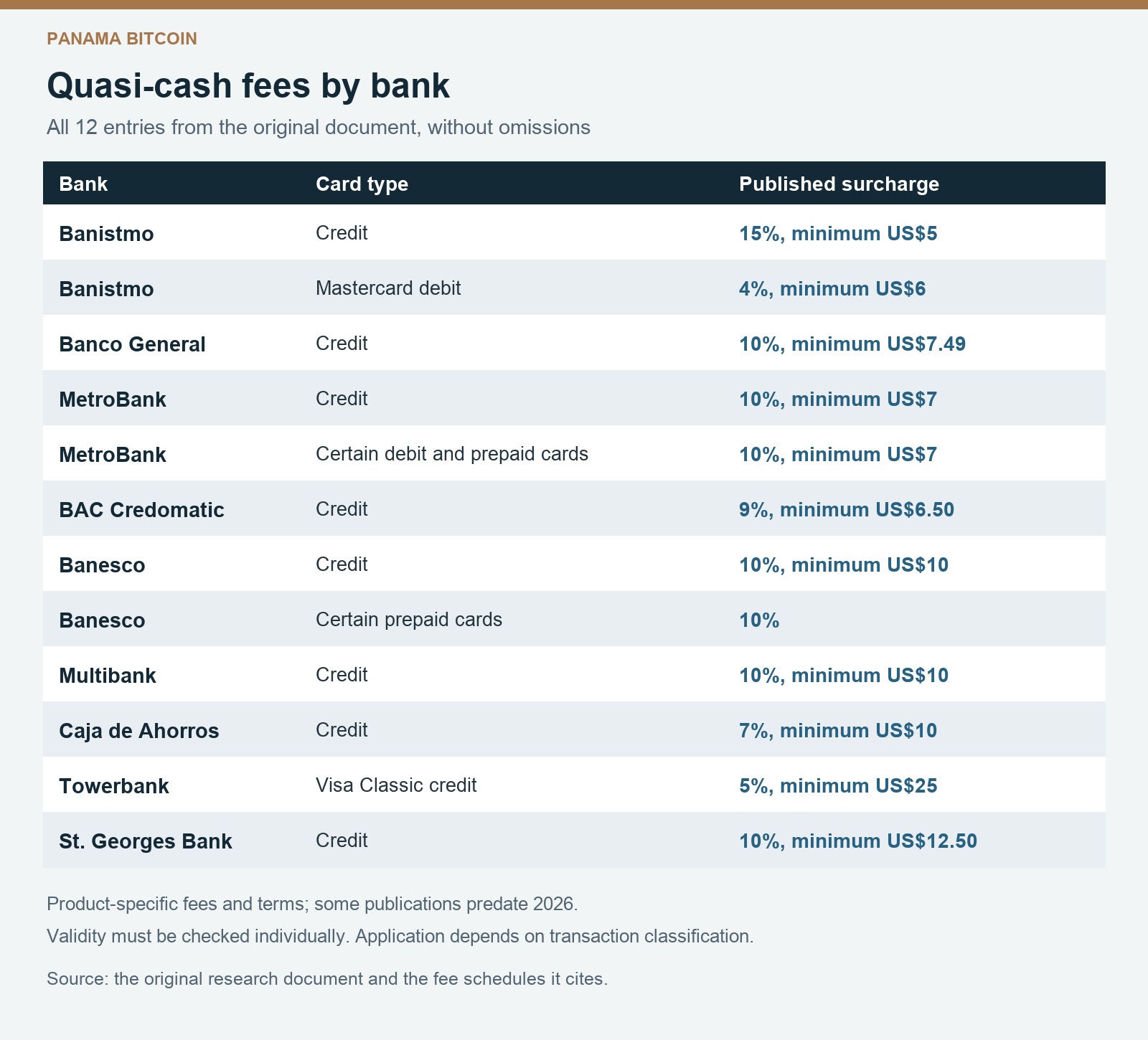
A review of fee schedules published by institutions in Panama's banking market identifies the following fees:
| Bank | Card type | Published surcharge |
|---|---|---|
| Banistmo | Credit | 15%, minimum US$5 |
| Banistmo | Mastercard debit | 4%, minimum US$6 |
| Banco General | Credit | 10%, minimum US$7.49 |
| MetroBank | Credit | 10%, minimum US$7 |
| MetroBank | Certain debit and prepaid cards | 10%, minimum US$7 |
| BAC Credomatic | Credit | 9%, minimum US$6.50 |
| Banesco | Credit | 10%, minimum US$10 |
| Banesco | Certain prepaid cards | 10% |
| Multibank | Credit | 10%, minimum US$10 |
| Caja de Ahorros | Credit | 7%, minimum US$10 |
| Towerbank | Visa Classic credit | 5%, minimum US$25 |
| St. Georges Bank | Credit | 10%, minimum US$12.50 |
These percentages correspond to fee schedules and terms for specific products. Some publications predate 2026, so their continued validity must be confirmed individually. Their actual application to Bitcoin also depends on how each transaction is classified.
In certain cases, such as Banistmo, BAC Credomatic, and Banesco, the banks' documents include explicit references to cryptocurrencies or digital asset exchange platforms.
But the question does not end with which banks charge these fees.
Which banks allow people to acquire Bitcoin without applying an extraordinary surcharge?
So far, we have been unable to verify an official public list identifying which institutions guarantee a 0% fee for cryptocurrency purchases with cards.
Nor is there a centralized comparison that makes it easy to distinguish between banks that charge these fees, those that do not, and those that restrict these transactions.
Failing to find a published fee does not prove that the charge does not exist, either.
Why does an economy that presents itself as an international financial center lack a public tool that allows its citizens to compare these costs?
The information exists, scattered across contracts, annexes, and fee schedules. But consumers should not have to become legal researchers to discover how much their own bank will charge them.
The Fine Print: These Fees Have Been Documented for Years
Quasi-Cash surcharges applicable to cryptocurrencies are not new.
A particularly clear example appears in Banco General's personal credit card agreement, in its November 2018 version.
The document explicitly includes transactions involving virtual currencies and cryptocurrencies within its provisions relating to quasi-cash.
It also establishes that certain transactions may be accepted or rejected at the discretion of the bank and the card networks.
Annex I, page 11 of 12, lists a 10% fee for Quasi-Cash transactions, including virtual currencies, with a minimum of US$7.49 and the corresponding tax treatment.
This demonstrates that at least one major institution explicitly provided for these terms eight years ago.
But the situation is not exclusive to that bank.
Other institutions' fee schedules also document similar charges, while the general regulatory framework governing bank fees dates back to Agreement No. 4-2011 of the Superintendency of Banks, effective January 1, 2012, and subsequently amended.
This Agreement allows banks to establish fees, but also provides that they must correspond to services actually provided or expenses incurred.
We have not identified any provision requiring all Panamanian banks to charge specific percentages for acquiring Bitcoin.
This makes Quasi-Cash fees a matter deserving examination, both individually and across the sector, of their commercial and regulatory foundations.
And it raises another question.
How many cardholders really understand the implications of the clauses they accepted when signing up for their cards?
There is a difference between publishing a fee in a lengthy document and ensuring that the customer understands its impact before carrying out a transaction.
Transparency should not be hidden in the fine print of contracts that few consumers read in full.
A Bank Fee or an Economic Penalty?
Consider someone who wishes to acquire US$10,000 in Bitcoin.
If their bank applies a 10% surcharge, they will have to pay an additional US$1,000.
If the surcharge reaches 15%, they will pay US$1,500.
And if a 7% ITBMS is also applied to that fee, the total cost will be even higher.
In the second scenario, the consumer would pay US$11,605 to acquire US$10,000 in Bitcoin, excluding exchange fees.
That means they would need an appreciation of approximately 16.05% to recover their outlay, assuming there are no other costs.
This is not an insignificant cost.
It is a reduction in the investor's available wealth or a considerable increase in the acquisition cost.
From a legal standpoint, these fees do not automatically constitute fines or sanctions.
But from an economic perspective, they can function as a de facto penalty.
The customer is not necessarily breaching any obligation or carrying out an illegal transaction.
They are simply using their card to acquire a different asset.
The question is whether the costs and risks of that transaction objectively justify the percentage charged.
Banks may cite fraud, credit, chargeback, liquidity, and regulatory compliance risks.
These are legitimate risks that deserve attention.
However, classifying a transaction as quasi-cash does not, in itself, demonstrate that a 10% or 15% fee is proportionate.
The commercial classification and the economic justification for the fee are different matters.
When Choosing Money Also Means Expressing a Conviction
Freedom of expression is usually associated with the written word, public discourse, and the expression of ideas.
But our economic decisions can also communicate preferences and values.
Choosing Bitcoin can represent trust in a monetary system with a limited supply, in a decentralized network, or in the ability to transfer value without relying exclusively on a financial institution.
It is therefore legitimate to raise the expressive dimension of monetary freedom.
If an institution significantly increases the cost of accessing a financial alternative, can that surcharge function as a form of economic censorship?
The question deserves reflection.
Not every fee constitutes censorship, nor is every monetary decision automatically legally protected as freedom of expression.
But the economic effects of a measure can discourage behavior without any need to prohibit it.
A 15% surcharge does not formally prevent anyone from buying Bitcoin.
However, it can make that choice an economically less accessible alternative.
And when the intermediary that establishes that barrier also controls important channels of access to the financial system, the debate is no longer confined to private contracts.
It begins to involve issues of economic power, competition, and individual autonomy.
Telered: Who Controls Panama's Interbank Payment Infrastructure?

Here we find one of the most important aspects of Panama's financial system.
Telered, S.A. operates fundamental infrastructures for the country's electronic payments, including ACH systems, ACH Xpress, ATM networks, and other processing services.
In practice, Telered occupies a central position in the processing of domestic retail interbank transfers.
This operational concentration is particularly relevant because we are not talking about an ordinary business competing to sell a product.
We are talking about infrastructure used by a significant portion of the financial system to allow money to circulate between institutions.
According to the report Payment Systems and Digital Financial Services in Panama, prepared by the World Bank in November 2023, Telered is a private company owned by a consortium that, at the time of the report, comprised six banks: Banco General, Banistmo, BAC, Banco Nacional de Panamá, Capital Bank, and Citibank.
In other words, a central part of the infrastructure that enables interbank payments is owned by financial institutions that also operate commercially in that same market.
The importance of this structure is not merely technological.
It is economic and competitive.
Banco General's consolidated financial statements for 2025 identify a 40% stake in Telered.
The same financial statements present information for Telered as of November 30, 2025, showing approximately:
- US$53.4 million in revenue.
- US$42 million in expenses.
- US$11.4 million in net income.
These figures relate to Telered's reported activities as a whole. They do not represent Quasi-Cash revenue or demonstrate that they come from cryptocurrency transactions.
But they help put the economic value of administering payment infrastructure into perspective.
The existence of a central operator can offer economies of scale, efficiency, and shared standards.
However, it also raises questions about governance, access for new participants, fees, interoperability, and potential conflicts of interest.
Under what conditions can a nonbank fintech company access these infrastructures?
Who determines the commercial and technical requirements for participation?
What mechanisms ensure that shareholders and established participants do not receive unjustified advantages over new competitors?
And who oversees whether access decisions are based on objective criteria rather than particular commercial interests?
These questions do not imply that Telered has engaged in illegal monopolistic practices.
But infrastructure with a central position in the market deserves a level of transparency proportionate to its economic importance.
Yappy: When a Payment Platform Becomes Part of Everyday Life
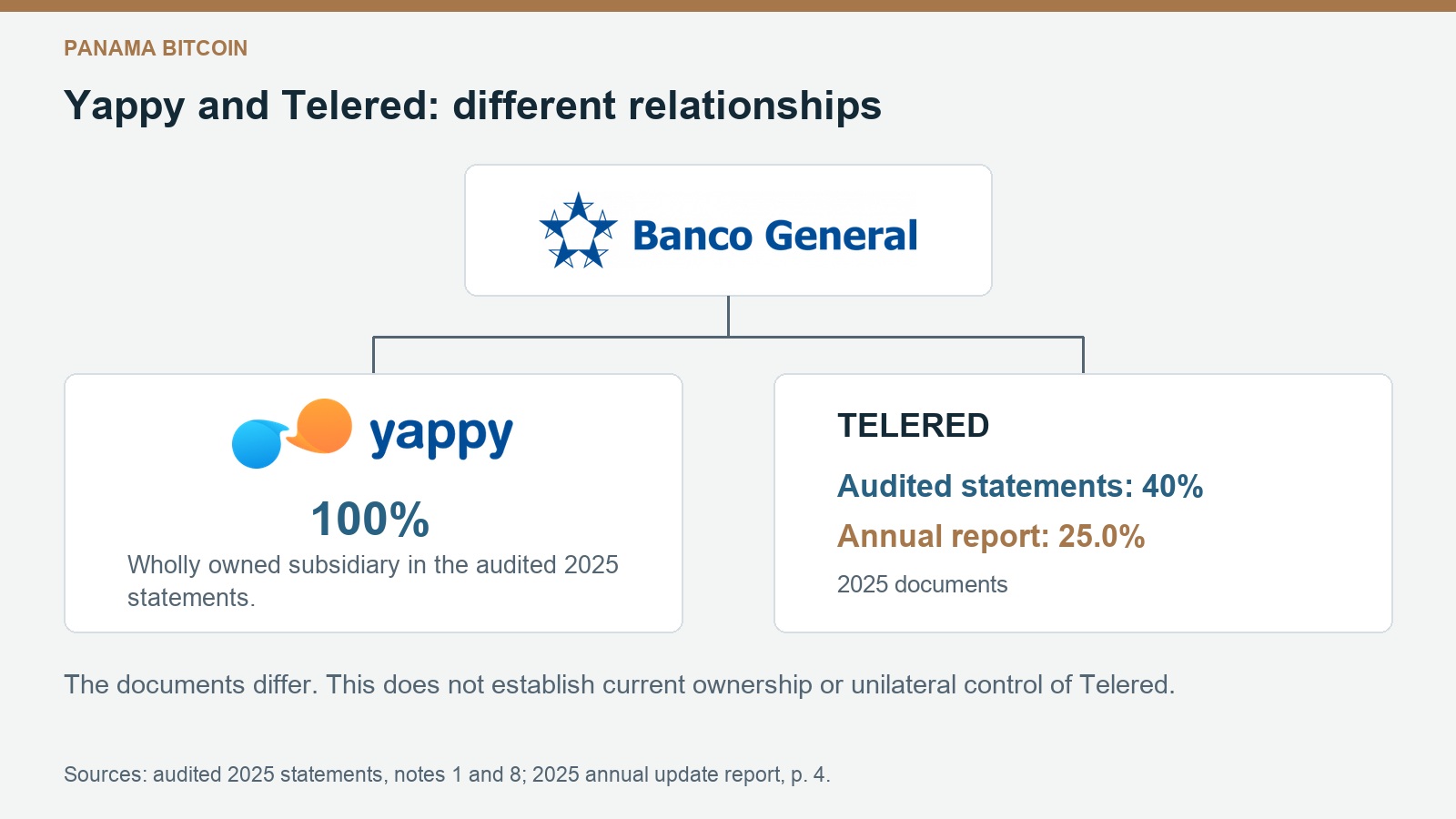
Visual identity: Banco General / Yappy.
The other important component of this discussion is Yappy.
What began as a tool for sending money using telephone numbers has become a payment platform widely used by Panamanian consumers and businesses.
Yappy, S.A. is part of the Banco General group, which identifies it as a wholly owned subsidiary in its consolidated financial statements.
The platform has also brought other banking institutions on board, expanding its reach beyond the customers of a single institution.
According to Banco General's 2025 Responsible Banking Report, Yappy closed that year with approximately 1.75 million customers and affiliated businesses and an average of 55.3 million monthly transactions.
In October 2026, information published in La Prensa reported statements by Yappy's management placing the platform at more than 1.8 million customers and around 78 million monthly transactions.
These figures show the extent to which a payment platform can become everyday infrastructure for a significant portion of the population.
Its popularity represents a commercial and technological achievement.
But it also creates network effects: the more users and businesses participate, the more valuable the platform becomes, and the harder it may be for new competitors to reach a comparable scale.
This does not automatically make Yappy an illegal monopoly.
Nor does it demonstrate that its owners are trying to prevent the development of alternative payment methods.
However, its size and its connection to a major banking group make it reasonable to examine the conditions of competition and interoperability.
The issue is not to question a company's right to develop a successful platform.
It is to ensure that this success does not ultimately become, through unjustified barriers, a limitation on the entry of new alternatives.
A Structure of Interests That Deserves Scrutiny
The relationship between banks, clearing infrastructures, and payment platforms raises an important issue for Panama's financial policy.
A banking group may participate simultaneously in different market segments: card issuance, bank accounts, transaction processing, and payment infrastructure.
These business holdings can be perfectly legitimate.
They can also generate efficiencies and benefits for consumers.
But from a competition perspective, there is a fundamental question:
What happens when an institution that participates in essential infrastructures also competes with the providers that need access to them?
In Panama's case, Banco General's documented stake in Telered and its ownership of Yappy reveal a corporate presence at different levels of the payments ecosystem.
That does not demonstrate the existence of a strategy to block Bitcoin or that the institution unilaterally controls all of Telered's decisions.
But it does constitute a structure that should be evaluated from the perspective of governance, nondiscriminatory access, and potential conflicts of interest.
And the discussion must be extended to the other banks participating in shared infrastructures.
Because this is not a debate about a single institution.
It is a debate about how economic power is distributed within Panama's financial system.
The World Bank Has Already Warned of Competition Problems
This discussion has a particularly relevant institutional precedent.
In November 2023, the World Bank published its technical note on Panama's payment systems and digital financial services, as part of the Financial Sector Assessment Program conducted jointly with the International Monetary Fund.
The document, available on the Superintendency of Banks' website, identifies concerns relating to competition and access to financial infrastructures.
In paragraphs 51 and 52, the report notes that enforcement of antimonopoly provisions in the financial sector had been limited.
It also documents that nonbank fintech companies reported difficulties opening bank accounts and accessing financial infrastructures.
And it warns of the risk that certain closed-loop payment systems could develop de facto monopoly positions because of their network effects.
It is important to clarify that these warnings do not constitute a finding of guilt against Telered, Yappy, or a specific bank.
But they do confirm that concerns about access, concentration, and market power are not merely speculation within the Bitcoin ecosystem.
These are problems that have already been identified in an international assessment of Panama's financial system.
The debate about integrating digital assets therefore cannot be separated from the debate about competition in payment methods.
Bitcoin and Blockchain: Competition That Does Not Depend Exclusively on Banks
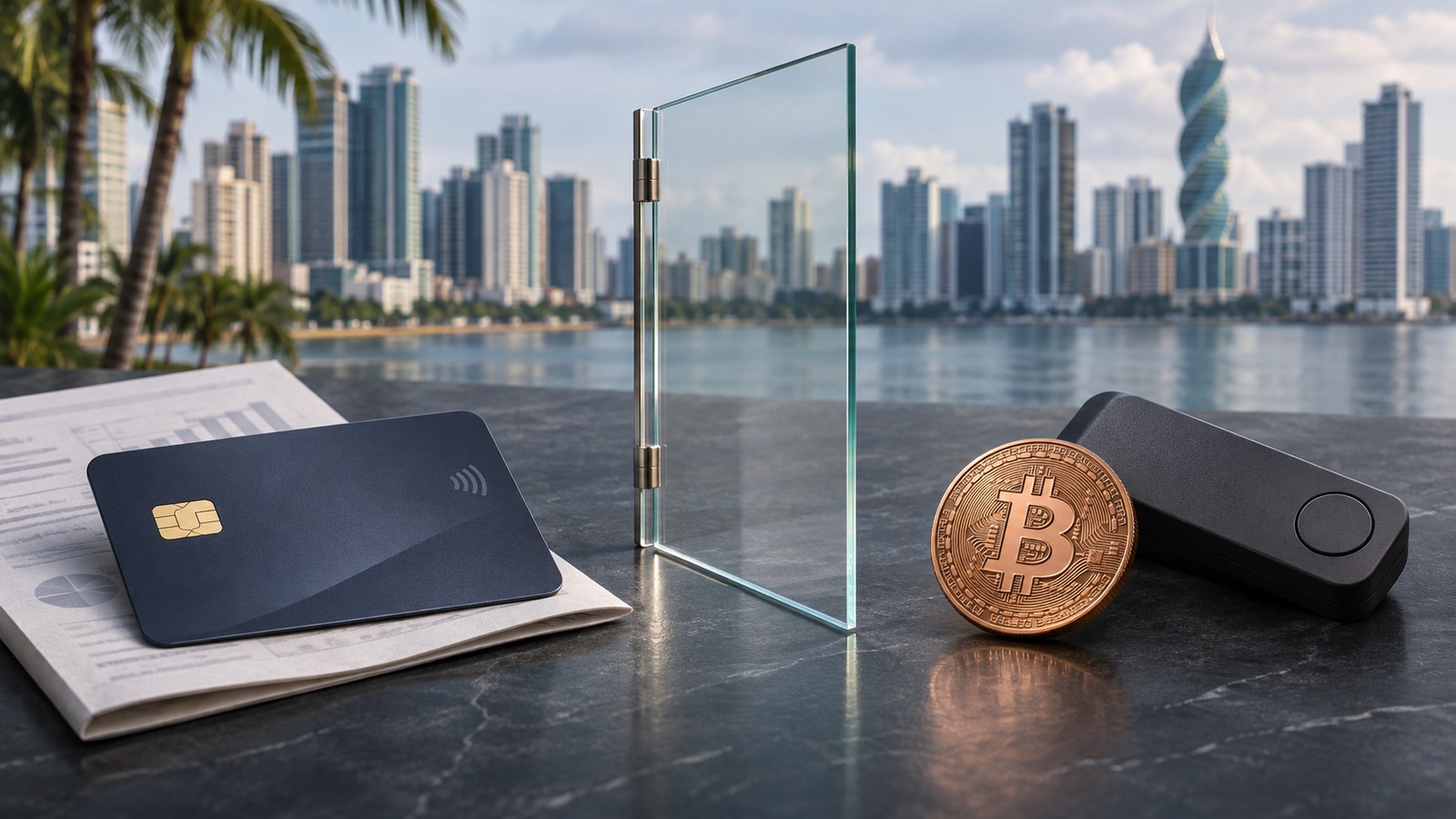
Bitcoin introduced a technological possibility: transferring value through an open network that does not require a traditional bank to authorize every movement between its participants.
Stablecoins and other blockchain applications expand these possibilities through digital instruments that can be used for payments, settlements, and international transfers.
These technologies do not eliminate the need for rules, compliance controls, or financial providers when assets are converted or intermediated services are provided.
But they do offer alternatives to certain functions traditionally concentrated in financial institutions.
In an economy such as Panama's, this could create opportunities for merchants, investors, exporting businesses, independent workers, and international service providers.
It could also generate competition for some existing transfer and processing models.
From this perspective, it is legitimate to ask whether all participants in the financial system have the same incentives to facilitate that integration.
Greater competition could reduce certain fees and open up new opportunities.
But it could also affect existing revenue.
The existence of these economic incentives does not, in itself, demonstrate anticompetitive conduct.
However, it would be a mistake to ignore them when designing policies for regulation and financial integration.
How Much Money Is at Stake?
The central question of this investigation remains unanswered.
How much money have Panamanian banks collected in Quasi-Cash fees specifically related to cryptocurrencies?
We have not identified a consolidated public figure.
Nor have we found a report breaking down that revenue by institution, year, and merchant category.
To illustrate the potential scale, we can use hypothetical scenarios.
| Annual volume subject to surcharge | 5% fee | 10% fee | 15% fee |
|---|---|---|---|
| US$25 million | US$1.25 million | US$2.5 million | US$3.75 million |
| US$100 million | US$5 million | US$10 million | US$15 million |
| US$250 million | US$12.5 million | US$25 million | US$37.5 million |
These figures are mathematical exercises, not verified estimates of actual bank revenue.
We do not know the volume of purchases actually processed through cards, what percentage was subject to a surcharge, or how much corresponds to Bitcoin.
It is also necessary to distinguish Quasi-Cash revenue from the revenue of operators such as Telered or payment platforms. These are different activities and revenue sources and should not be added together as though they constituted a single fee.
That is precisely why we need official figures.
If cryptocurrency fees produce marginal revenue, knowing that would allow us to evaluate the hypothesis that they represent an important economic incentive.
If they generate significant amounts, it would be appropriate to examine whether those fee structures influence commercial decisions and the conditions of competition.
The answer should not depend on conjecture.
It should depend on data.
Why Don't Banks Publish How Much They Have Collected?
The Superintendency of Banks publishes extensive information on the financial system's assets, deposits, loans, and results.
Banks, for their part, disclose fee schedules and financial statements.
However, Quasi-Cash revenue is not clearly broken down in the public statistics we have been able to identify.
It may be included within broader accounting categories.
It is also possible that the regulator has internal information that is not published at that level of detail.
But consumers should not have to accept this absence of information as inevitable.
Every fee paid represents a transfer of resources from the customer to the financial institution.
This does not necessarily mean that the money leaves the Panamanian economy, but it does constitute a cost that reduces the consumer's available resources.
How much does that accumulated cost amount to over the last eight years?
How much relates to cryptocurrencies?
How many transactions have been rejected?
What is the average fee actually charged?
And what are the economic justifications for these percentages?
Transparency should make it possible to answer these questions.
The Same Rules Must Apply to Everyone

When digital assets are discussed, traditional financial institutions often emphasize the importance of supervision, due diligence, anti-money-laundering controls, and consumer protection.
These are legitimate principles that should apply to any financial provider.
But regulatory consistency requires that the same criteria of transparency, proportionality, and competition also apply to established participants.
If a digital asset company must explain its fee structure, its risks, and its compliance mechanisms, banks should also be able to explain the extraordinary charges they apply to their customers.
If transparency is required of new payment providers, transparency should also be required regarding the conditions of access to and governance of traditional infrastructures.
And if the concentration of risks in digital asset platforms is a concern, the operational concentration of conventional systems should also be examined.
Supervision should not treat innovation as a threat by default or presume that traditional participants are free of conflicts of interest.
The same rules must apply to everyone, including those who have spent decades administering and benefiting from the existing financial infrastructure.
The Superintendency and the Banking Association Must Promote Greater Transparency
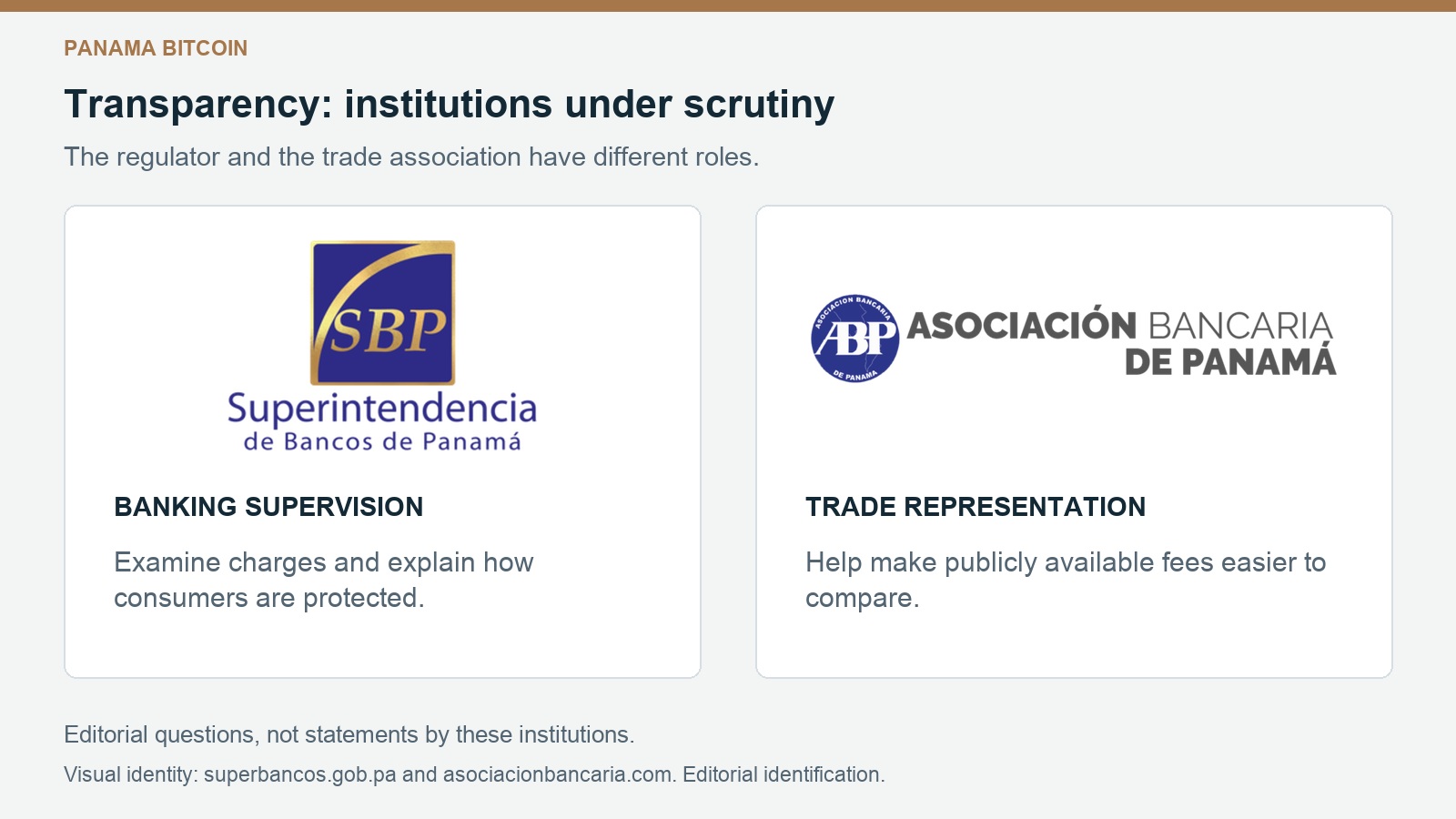
Visual identity: Superintendencia de Bancos de Panamá / Asociación Bancaria de Panamá.
At Panamá Bitcoin, we believe it is necessary for the Superintendency of Banks of Panama to promote a public review of Quasi-Cash fees and their impact on consumers.
We also believe that the Banking Association of Panama should promote the voluntary disclosure of comparable information among its members.
We propose the publication of a report that makes the following information available:
- The Quasi-Cash fees applied by each bank, distinguishing between credit, debit, and prepaid cards.
- The institutions that allow purchases of Bitcoin and other digital assets without additional surcharges, as well as those that restrict these transactions.
- Annual Quasi-Cash revenue from 2018 through 2025 and the accumulated total for 2026.
- A breakdown of that revenue among cryptocurrencies, foreign currencies, money orders, gambling, account funding, and other categories.
- The volume of transactions processed, the charges actually applied, and the corresponding percentages.
- The criteria for classifying transactions and the economic justification for the fees.
- The mechanisms through which cardholders are informed of fees before authorizing their transactions.
- The conditions of access, interoperability, and governance of the main domestic payment infrastructures.
This information should be published in compliance with confidentiality and data protection rules, as well as legal restrictions applicable to commercially sensitive information.
But protecting private information should not be confused with an inability to disclose public fees and aggregate statistics.
In parallel, ACODECO should examine the conditions of competition in the digital payments market, including the barriers faced by nonbank providers and fintech companies in accessing essential infrastructures.
Who Should Decide What Money We Can Use?
Panama has an important opportunity to become a center of financial innovation.
Its banking infrastructure, dollarized economy, experience in international services, and trade connectivity represent competitive advantages.
But none of these strengths should be used as an argument for artificially preserving certain market structures in the face of new technologies.
Traditional banking can evolve, integrate digital assets, offer custody, settlement, and conversion services, and compete within a broader financial ecosystem.
Bitcoin does not need to exclude banks in order to develop, either.
What consumers need is the freedom to choose among transparent and competitive alternatives.
And that freedom requires knowing the real costs of financial decisions.
We cannot assert without evidence that Panamanian banking is deliberately blocking Bitcoin integration to protect its fee revenue or its stakes in payment systems.
But we can demand an examination of the economic incentives, access conditions, and potential conflicts of interest that could influence that process.
The existence of concentrated infrastructures and high charges deserves scrutiny, not because it demonstrates a violation in itself, but because it directly affects consumers' ability to choose and compete.
Monetary Freedom Begins with Transparency
Money represents work, savings, time, and effort.
But it also represents decisions.
When we choose a form of money, we are expressing a preference about how we want to preserve and transfer the value of our work.
That decision should not be constrained by opaque surcharges or unjustified commercial barriers.
Financial freedom does not mean that all services must be free.
It means that their costs must be clear, their risks understandable, and their terms compatible with effective competition.
That is why the debate about Quasi-Cash is not merely a debate about cryptocurrencies.
It is a debate about the power of financial institutions, contractual transparency, infrastructure concentration, and consumers' right to know how the system they use every day is administered.
How much money have Panamanian banks collected through economic penalties associated with acquiring Bitcoin?
What costs justify these fees?
What economic incentives might exist to preserve certain payment models in the face of blockchain-based alternatives?
And how can we ensure that existing financial infrastructures do not become unjustified barriers for those who wish to innovate?
The Superintendency of Banks, the Banking Association, and the competition authorities should help answer these questions publicly.
Because if banking demands transparency, compliance, and responsibility from new participants, it must be willing to subject its own practices to the same level of scrutiny.
And because Panamanian consumers deserve to know not only how much it costs to use their money, but also who sets those conditions, who benefits economically from them, and what alternatives they really have available.
The freedom to choose money should not become a privilege reserved for those who can afford extraordinary fees.
Panamá Bitcoin: For monetary freedom, transparency, and financial competition.
Documentary Sources
Superintendency of Banks of Panama
- Agreement No. 4-2011 on bank fees and surcharges: https://www.superbancos.gob.pa/documentos/leyes_y_regulaciones/acuerdos/2011/Compilado_Acuerdo_4-2011.pdf
- Agreement No. 7-2026: https://www.superbancos.gob.pa/node/1790?page=0
World Bank
- Payment Systems and Digital Financial Services, November 2023. Paragraphs 51, 52, and 79: https://www.superbancos.gob.pa/documentos/evaluaciones_fmi/NT-SPN-Pagos-Panama-Payments-TN.pdf
Infrastructure and Corporate Structure
- Banco General, 2025 consolidated financial statements, notes 1 and 8: https://www.bgeneral.com/informacion-corporativa/
- Telered, participating institutions: https://www.telered.com.pa/ach/miembrosredach/
- Yappy, participating banks: https://www.yappy.com.pa/bancos-con-yappy/
Fee Schedules and Contracts
- Banistmo: https://www.banistmo.com/acerca-de/tarifario
- Banco General: https://www.bgeneral.com/tasas-comisiones-recargos/
- Banco General agreement, November 2018: https://www.bgeneral.com/wp-content/uploads/2018/12/PC8348-TDC-CONTRATO-PARA-LA-EMISION-Y-USO-DE-LAS-TARJETAS-DE-CREDITO-PERSONAL-NOV18.pdf
- MetroBank: https://www.metrobanksa.com/tarifario/
- BAC Credomatic: https://www.baccredomatic.com/es-pa/personas/landing/tarifas
- Banesco: https://www.banesco.com.pa/cargos-y-comisiones-de-servicios-bancarios-banesco/
- Multibank: https://www.multibank.com.pa/
- Caja de Ahorros: https://www.cajadeahorros.com.pa/tarifario/
- Towerbank: https://www.towerbank.com/tarjetas/visa-classic
- St. Georges Bank: https://www.stgeorgesbank.com/
Note: The fees correspond to fee schedules and products identified during the investigation. They do not constitute a universal certification of the current fees for all cards or a determination regarding anticompetitive practices. Specific Quasi-Cash revenue related to cryptocurrencies has not been quantifiable through verified public statistics.
A Fact That Particularly Strengthens This Article
The argument concerning Telered and Yappy does not depend solely on assessments of market concentration:
-
The World Bank identifies Telered as owned by a consortium of six banks in its 2023 report. superbancos.gob.pa
-
Banco General's 2025 consolidated financial statements document its 40% stake in Telered, its ownership of Yappy, and Telered's financial results. Banco General Panamá
-
The World Bank also noted difficulties faced by nonbank fintech companies in accessing accounts and financial infrastructures, as well as risks of market power. superbancos.gob.pa
These documents provide a basis for discussing structural concentration, access to infrastructure, and economic incentives. What remains to be demonstrated is whether those interests have translated into specific decisions intended to exclude or harm digital asset providers. That is one of the issues the article proposes investigating.
Editorial note: clarifications, corrections and right of reply
This investigation is published in good faith and with the aim of contributing to the debate on transparency, competition and consumer protection in Panama's financial system. We have sought to support the information with documentary references, prioritizing the fee schedules, contracts, reports and other publications of the entities mentioned themselves, and to follow good practices in verification and source attribution.
Our intention is not to unfairly harm the reputation of any institution, its staff or its customers. We recognize that documents may be updated and that certain terms require clarification regarding their date, scope or application.
Panama Bitcoin invites all entities and individuals mentioned to exercise their right of reply and to notify us of any error, clarification or update they consider necessary, by writing to info@bitcoinpanama.org. We would appreciate identification of the relevant passage and, where possible, supporting documentation.
We will review communications received diligently and impartially. Where appropriate, we will incorporate relevant corrections, clarifications or responses, recording substantive changes. This space remains open to dialogue and documentary cross-checking, without relinquishing critical examination of matters of public interest.